Primary 3–6
Build foundations and develop ideas.
Work on vocabulary and grammar in context, comprehension, composition and oral expression. Adjust the amount of explanation and practice to the child’s starting point.

Personalised English home tuition
One-to-one, face-to-face English lessons at your home, for Primary 3 to Secondary 3.
Reading, writing and oral communication taught with close attention to your child’s work, Singapore school expectations and the next skill to develop.
NIE-trained educator · MOE-school teaching experience
Serving Choa Chu Kang and surrounding areas, including Woodlands and the Bukit Timah corridor up to Adam Road, subject to location and available lesson slots.
Prefer email? academy@auryzen.com
Primary learners
Develop a composition, strengthen sentences and explain an answer with relevant support.
Secondary learners
Interpret a text, connect evidence to a point and develop a purposeful written or spoken response.
Illustrative learning priorities. The starting point depends on your child’s work.
English lessons at home
All current lessons are taught personally by Mr Mosman, one-to-one at the student’s home. Content, pacing and practice respond to the learner’s level and needs.
English reading, writing, language and oral work, suited to your child’s stage.
Face-to-face home lessons, with focused explanation and guided practice.
Serving Choa Chu Kang and surrounding areas, including Woodlands and the Bukit Timah corridor up to Adam Road, subject to location and available lesson slots.
Primary 3–6
Work on vocabulary and grammar in context, comprehension, composition and oral expression. Adjust the amount of explanation and practice to the child’s starting point.
Secondary 1–3
Develop inference, evidence selection, summary where relevant, and more sustained written and spoken responses. Connect the teaching with the student’s school tasks and subject-level expectations.
Singapore school context
Teaching draws on familiarity with the MOE English Language syllabus, Singapore students’ classroom experiences and school assessment settings. Work may include composition, situational writing, comprehension, grammar, vocabulary and oral communication, as appropriate to the learner’s level and pathway.
School tasks and relevant examination requirements help set the context. Lessons also make space for listening, viewing, wider reading, imaginative writing and discussion. The aim is understanding and purposeful language use beyond a particular worksheet or test.
Auryzen Academy provides independent tuition. Curriculum familiarity does not imply MOE or SEAB endorsement.
Within your English lessons
Understand a text.
Develop a response.
Communication Lab is the learning environment used within Mr Mosman’s English lessons. Students read, discuss and write about ideas, moving between understanding a text and developing their own response.
NewsThink
Read, question, discuss, write.
Where suitable, Mr Mosman uses an age-appropriate news article to help students understand a text, ask purposeful questions and discuss their ideas before developing a written response. Sources may include CNA and The Straits Times, selected for the topic, reading demand and learner. Articles are discussed with attention to what the source says and what supports a response.
Current teaching focus
Composition, situational writing, sentence control and revision for purpose and audience.
Inference, relevant evidence and supported explanations; summary skills where appropriate.
Develop reasons and examples, respond thoughtfully, and connect discussion with writing.
From current work to the next lesson
A recent EOY English paper, composition or piece of classwork offers a useful starting point. Mr Mosman reviews the responses and feedback, identifies a teaching priority and plans focused intervention. Later work helps show what the learner can apply.
Review the actual answers, task demands, school feedback and any help given.
Look for patterns in understanding, reasoning or language use. Check an interpretation with further work where needed.
Use explanation, modelling and guided practice matched to the priority and learner.
Return to the skill in suitable later work and adjust teaching according to the response.
A paper gives a snapshot of the tasks assessed. A supported correction is useful practice; a fresh response helps check what the student can do independently.
What we notice
A primary composition moves quickly from one event to the next, with little detail about the character’s actions or choices.
A possible teaching response
Choose an important moment. Rehearse what happened, then develop relevant action, detail and a character response in the student’s own words.
A later independent check
Use a different story situation. Can the learner develop a moment with meaningful detail and less prompting?
Fictional teaching examples, not student results. Lessons are adapted to the learner and the task.
Your tutor
Teacher training.
Classroom experience.
Individual attention.
Your child’s lessons are planned and taught by Mr Mosman himself.
Meet Mr Mosman
Founder and Principal Tutor · Auryzen Academy
An NIE-trained educator, Mr Mosman brings teaching experience in Singapore MOE schools and international-school settings to his current personalised English practice.
His experience includes differentiated lessons, assessment and marking, and working with learners at different starting points. In one-to-one tuition, this informs how he explains a difficulty, adjusts support and selects the next practice task.
Discuss a lesson with Mr MosmanParent feedback
“Very dedicated and gives very truthful feedback on my kids’ progress.”
“Mr Mosman is a patient and encouraging tutor who explains English vocabulary and grammar clearly and in detail. He is engaging during lessons and builds good rapport with my child. He uses news articles to make lessons more interesting and to develop oral and discussion skills.”
Our teaching charter
Our teaching charter connects what your child learns with how we teach, give feedback and discuss progress.
Make sense of what is read, heard and seen, and express ideas with understanding.
Ask questions, make connections and support interpretations with relevant evidence.
Choose language that serves the purpose, audience and situation.
Use the learner’s work to choose suitable explanation, practice, feedback and support.
Build confidence in making choices, checking work and seeking useful help.
Return to learning over time and check how it is used in a different task or context.
The aim is for your child to understand, explain and communicate with growing independence, and to use what they learn in new situations.
Read the teaching charterA free guide for parents · Primary 3–6
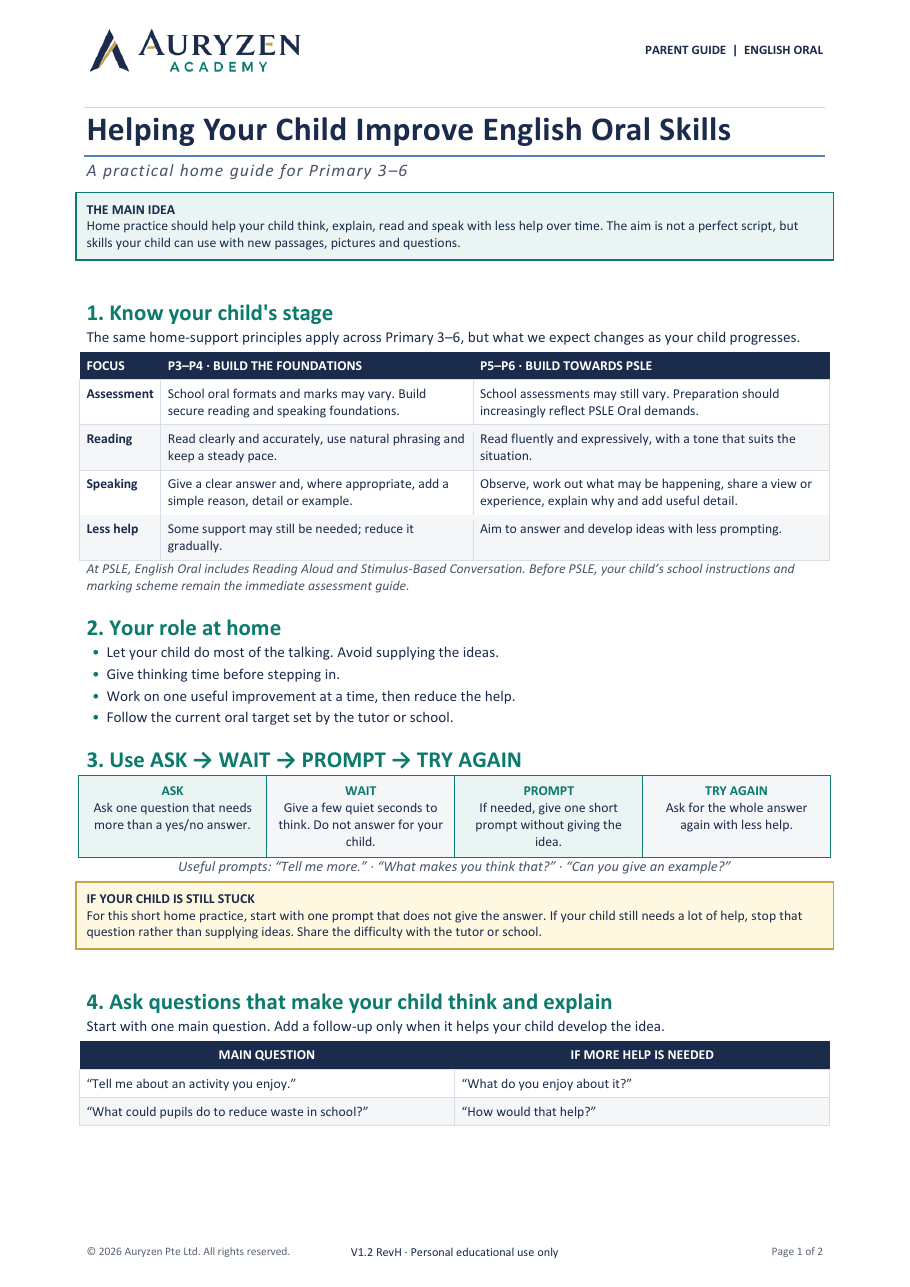
A short English oral guide with practical ways to support reading aloud and conversation at home. Give thinking time, offer a useful prompt and let your child try again.
Explore the free oral guide2 pages · PDF · No email or sign-up required.
Practice that supports the lesson
Short, focused activities give students another opportunity to practise a skill from their lessons. Mr Mosman selects missions suited to the learner’s current priority.
Practice connects back to reading, speaking and writing. A fresh whole-task response and a later check can help Mr Mosman review independent use; completion alone does not establish mastery or transfer.
Our teaching routes are Explorer (Primary 3–4), Adventurer (Primary 5–6), Navigator (Secondary 1–2) and Strategist (Secondary 3 onwards within actual competence). Current home-tuition enrolment remains Primary 3 to Secondary 3. These routes organise teaching; they are not proficiency ratings or official subject levels.
Try the visitor demo ↗ · Missions practice, access and privacy
Student mission access in a new tabFor assigned student activities. Mr Mosman provides access instructions.
An illustrative practice sequence
Choose a word that fits its context.
Say why that choice makes sense.
Use the word in a different sentence.
A teaching illustration, not a claim about any student’s results.
Looking ahead to the December holidays
Recently completed EOY English papers offer a timely starting point for reviewing current performance. Ask Mr Mosman to analyse the answers and school feedback, identify areas that need attention and discuss targeted teaching or practice.
The review can consider comprehension, writing and language use. Mr Mosman may use further work to check a pattern before choosing targeted teaching and practice. Later responses help review progress.
Limited December lesson slots
Mr Mosman teaches every lesson personally. December 2026 availability is limited and depends on location and timetable fit.
Ask about an EOY paper review in a new tabBefore sharing a paper, agree the review scope, any fee and a suitable way to share it. An enquiry does not reserve a lesson slot.
Questions parents ask
New to home tuition? These are useful questions to discuss before making an arrangement.
Start with your child’s current level, the concern you want to address and what support they already receive. Mr Mosman can discuss these alongside his one-to-one teaching approach, your location and the available lesson times. Suitability should be discussed before lessons are agreed.
For the first enquiry, share your child’s level, neighbourhood and a brief learning concern. Once a suitable next step is agreed, Mr Mosman can discuss relevant marked work, school feedback or learning materials to review. Please do not send reports, scripts, your full address or sensitive information in an initial message.
The starting point depends on the learner and the information discussed beforehand. Suitable reading, writing or spoken work can help Mr Mosman see how your child approaches a task, explain a useful next step and adjust the level of support. It is not a fixed test that every student must sit.
Discuss a suitable lesson duration and frequency with Mr Mosman, taking account of your child’s current needs, school workload, attention and opportunities to practise between lessons. Confirm the agreed arrangement and fees before starting.
Ask Mr Mosman for the fee for the proposed lesson arrangement, any travel-related charge, and the payment, cancellation and rescheduling terms. An enquiry does not commit you to lessons or reserve a place. Any separate paper-review fee should also be agreed before the review begins.
Arrange a reasonably quiet, well-lit table and the school or learning materials agreed with Mr Mosman. Discuss parent or guardian arrangements and any practical needs beforehand. If digital practice is planned, discuss any device needed beforehand.
Tell Mr Mosman what your child finds difficult and what has or has not helped before. The teaching can begin with a manageable task and clear explanation, with support adjusted to the learner. Discuss any needs that affect participation so both sides can judge whether the arrangement is suitable.
For Primary 3–6, work can include vocabulary and sentence control, comprehension, composition and oral expression. For Secondary 1–3, tasks may place greater demands on inference, evidence, sustained writing and discussion. The amount of support depends on the student, rather than age alone.
Where a school uses PEEL or a similar paragraph structure, Mr Mosman can work with the school’s own labels, sequence and expectations. The focus is a clear point, relevant support and an explanation of why it matters. Not every response needs the same structure; direct answers, summaries and different writing tasks have their own demands.
Practice should serve the current learning priority and fit alongside schoolwork. Discuss an appropriate amount and how updates will be shared. Ask what skill a task develops, what your child has demonstrated and how much help was needed; a completed worksheet alone does not show independent use.
NewsThink uses an age-appropriate news article where it suits the learning goal. Articles may come from CNA, The Straits Times or another suitable source. Mr Mosman selects the reading demand and topic, explains context where needed and guides questioning, discussion and writing. Topics and reading demands are selected for the learner. Parents can raise a concern, and a suitable alternative task can address the same skill. NewsThink is one routine within a broader English experience.
Yes—ask about a review before sending the paper. Agree which components will be considered, the purpose, any fee and how it will be shared. A marked script and the school’s feedback can provide a baseline for the tasks assessed, help identify areas needing attention and guide targeted intervention. Further work may be needed to check a pattern. The review does not alter school marks, predict a grade or provide a validated overall English score.
Ask about December 2026 availability. Lesson slots are limited, and Mr Mosman will confirm whether your location, preferred times and learning needs fit the available arrangement. Holiday enquiries do not imply a separate intensive course or guaranteed place.
Current lessons are English only, face-to-face and one-to-one at the student’s home, for Primary 3 to Secondary 3. Serving Choa Chu Kang and surrounding areas, including Woodlands and the Bukit Timah corridor up to Adam Road, subject to location and available lesson slots.
Use the separate Micro Missions site and the access instructions provided by Mr Mosman. The tutor selects suitable activities to support lessons; it is not a public standalone subscription.
Current enrolment is for face-to-face personalised English lessons only. Parent workshops, adult communication and standalone digital learning products are development directions, not programmes currently open for booking. Any future offer will have its own scope and availability confirmed before enrolment.
Enquiries
For P3–Sec 3 English home tuition, tell Mr Mosman your child’s level, your neighbourhood and the learning concern you would like to discuss. He can then discuss suitability, travel, timetable and fees.